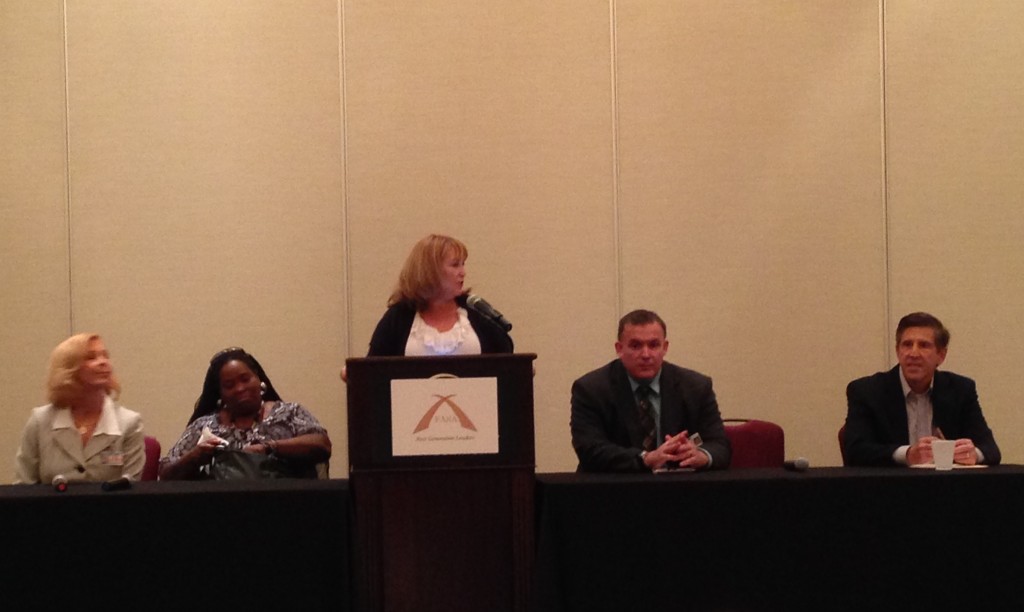
The word “accountability” can have different meanings in education policy debates. For two parents who spoke Thursday to a room full of public school administrators, it comes down to knowing what’s happening in their schools.
That includes test scores and other data that allow them to track their students’ progress. But it also involves other forms of transparency, including communication with the people who run their schools.
“As far as transparency, I know everything that’s going on. I feel completely connected, regardless of the distance,” Theresa Seits, the parent of two magnet school students, said during a panel at the Florida Association of School Administrators’ annual conference in Tampa. “Information is always available to me as far as how my students are doing, personally, and how the schools are doing as well.”
The word “accountability,” and competing arguments about how it should be achieved, have been at the center of debates over school choice in Florida and beyond. It came up repeatedly during Thursday’s panel discussion.
Seits, who is also an administrator at a Hillsborough County elementary school, said her oldest son could always get good grades and score well on tests. But he did not flourish until she enrolled him in the STEM magnet program at Hillsborough’s Middleton High School, where other kids shared his interest in technology and robotics. In other words, test scores showed her son was making progress, but she needed to find a school that met his needs on other counts. That, she said, “leaves a lot up to parents to have to research and understand” what options work best for their children.
Parent and panelist Shannon Coates said she, too, kept close tabs on what was happening in her daughter’s schools. Her daughter attended private schools with the help of the Florida tax credit scholarship program before moving to a performing arts conservatory in California. (The scholarship program is administered by Step Up For Students, which co-hosts this blog.)
But Coates said she also tracked her daughter’s progress using the results from standardized tests. That let her know her daughter was performing on grade level when she left eighth grade to focus on dance.
“Watching the scores and watching her growth on those test scores is something that empowers me and allows me to know that I made the right decision for my child,” she said.
Panelist Mat Romano, who oversees magnet programs for the Hillsborough County school district, said he knows the district’s choice programs are successful based on the number of students who apply. If the programs don’t perform, students won’t enroll. But he said the district’s choice programs also have to be accountable to the general public.
“We are using public money to fund these programs,” he said. “And with that we have that accountability to tell our taxpayers and our families in our district that we’re doing the best with that public money.”
That was the point raised by one member of the audience – Rocky Hanna, an administrator from Leon County Schools. He questioned whether schools with “no FCAT” and “very little teacher certifications” should receive “taxpayer dollars.”
Doug Tuthill, president of Step Up For Students and another panelist, said Hanna and his colleagues were “operating in a regulatory environment I don’t support.” Industries are typically either heavily regulated by the government, or regulated for safety guidelines but also subject to competition because consumers are able to make choices, Tuthill said.
He said the accountability system first put in place by Gov. Jeb Bush forces public schools, which students are often required to attend based on ZIP codes, to devote more resources to educating low-income children. That helps explain their improved results. But, he continued, with education moving toward customization and more students now choosing options beyond their zoned schools, “I really think we need less regulation and more choice.”